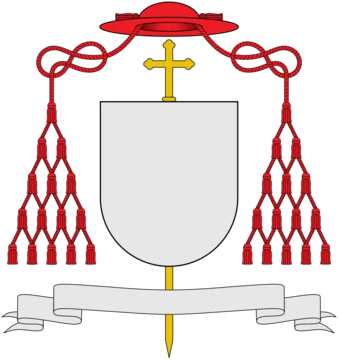
John Carroll (archbishop of Baltimore)
First Catholic bishop and archbishop of the United States.

Catholic Church. Born to an aristocratic family in colonial Maryland, he spent most of his early years as a priest in Europe before returning to organize the Catholic Church in America. He founded Georgetown University and St. John the Evangelist Parish, the first secular parish in the country.
- field
- Catholic prelate
- nationality
- American
- known_for
- First Catholic bishop and archbishop in the United States; founder of Georgetown University
Lore & Background
He was home-schooled by his mother, then sent to a secret Catholic school in Bohemia Manor, Maryland, run by Jesuit Reverend Thomas Poulton. At age 13, he and his cousin Charles Carroll were sent to the College of St. Omer in France. He remained in Europe until nearly age 40, teaching and serving as chaplain to a British aristocrat. John the Evangelist.
Reader's Guide
John Carroll's significance lies in his role as the foundational leader of the Catholic Church in the newly independent United States. Catholic Church. Carroll navigated the transition from colonial-era Catholic restrictions to a new republic where church and state were separated. He sought to build a church structure that balanced lay involvement with hierarchical control, and he worked to refute anti-Catholic slanders while advocating cooperation between Catholics and Protestants. His founding of Georgetown University in Washington, D.C., established the first Catholic institution of higher learning in the United States. Carroll also founded St. John the Evangelist Parish in Silver Spring, Maryland, the first secular parish in the country. His efforts to secure a voice for American clergy in selecting their bishop set a precedent for local input in church governance. Carroll's legacy is that of a pragmatist who helped shape an American Catholic identity distinct from European models, adapting to the principles of religious freedom and separation of church and state.
Did You Know?
- Carroll's older brother, Daniel Carroll II, signed both the Articles of Confederation and the US Constitution.
- Carroll's cousin, Charles Carroll, was the last surviving signer of the Declaration of Independence.
Aristocratic Roots and Jesuit Formation
John Carroll entered the world on January 8, 1735, at the Carroll family plantation in Upper Marlborough, Maryland, the son of Daniel Carroll I and Eleanor Darnall Carroll. His upbringing reflected the gentry of colonial Maryland, though his education had to navigate the legal restrictions placed on Catholics in the Province. His mother provided early instruction at home, and he later attended a clandestine Catholic school at Bohemia Manor, secretly run by Jesuit Father Thomas Poulton. At thirteen, Carroll and his cousin Charles were sent to the College of St. Omer in France, a well-known destination for wealthy Maryland Catholic boys. By eighteen, Carroll had entered the Society of Jesus as a postulant, and he spent the next two decades in Europe—studying philosophy and theology at a seminary in Liège, Belgium, where he was ordained in 1761. He taught at St. Omer and in Liège, and even served as chaplain to a British aristocrat. The papal suppression of the Jesuits in 1773 shattered that European career and sent him back to Maryland at nearly forty, a wound he never fully healed.
Architect of the American Catholic Church
The end of the American Revolution created both an opportunity and a crisis for American Catholics. The clergy had long fallen under the jurisdiction of the Apostolic Vicariate of the London District, but post-war anti-British feeling made that arrangement untenable. When Bishop James Talbot refused to exercise authority in the new nation, the Vatican needed a new solution. Carroll seized the moment. Beginning in June 1783, he convened a series of meetings at White Marsh Manor in Bowie, Maryland, gathering a small cadre of priests to begin organizing a distinctly American Catholic hierarchy. The Maryland clergy initially resisted the idea of an American bishop, but the papal nuncio in France turned to Benjamin Franklin for counsel. Franklin, mindful of separation of church and state, declined to make an official recommendation but privately praised Carroll's capabilities. On June 9, 1784, Pope Pius VI named Carroll provisional superior of the missions, granting him the power to administer confirmation. The appointment was reportedly made to please Franklin, and it set the stage for Carroll's eventual elevation to bishop in 1789 and archbishop in 1808.
Builder of Institutions and Advocate in Print
Carroll's vision for the American church extended well beyond spiritual leadership into the concrete world of buildings, schools, and parishes. In 1774, while still navigating the legal restrictions on Catholic worship in Maryland, he constructed a small chapel on the family plantation called St. John the Evangelist. That same spirit of institutional building carried into the post-Revolutionary era: in 1783, Carroll and a group of supporters launched a fundraising campaign for an Academy of Georgetown, the seed of what would become Georgetown University in Washington, D.C. He also established St. John the Evangelist Parish in Silver Spring, Maryland, recognized as the first secular parish in the country. Beyond construction, Carroll was a tireless advocate in print, publishing articles that pushed back against anti-Catholic slanders and misinformation circulating in the young republic. He also engaged in early ecumenical efforts, opposing proposals to establish a single Protestant denomination that would have marginalized Catholics further. His work as a missionary in both Maryland and Virginia during the war years, when no formal parish structures existed, demonstrated a practical, hands-on commitment to the faithful that shaped every institution he would later build.
A Family Woven into the Founding
John Carroll's personal story is inseparable from the broader narrative of American nation-building, largely because his family was so deeply embedded in it. His older brother Daniel Carroll II was one of only five men to sign both the Articles of Confederation in 1778 and the U.S. Constitution in 1787. His cousin Charles Carroll, the last surviving signer of the 1776 Declaration of Independence, lived until 1832 and even participated in the 1828 laying of the first stone for the Baltimore and Ohio Railroad. Carroll himself was drawn into the revolutionary diplomatic world when Charles persuaded him to join a 1776 Continental Congress mission to the British Province of Canada, aimed at winning French-Canadian support for the colonies. The mission failed—the bishop of Quebec forbade his priests from meeting the delegation—but Carroll's role included escorting the ailing Benjamin Franklin from Montreal back to Philadelphia. After that episode, he returned to the plantation to perform ministerial duties through the war years. These familial and personal connections to the founding generation underscore how deeply the Carroll name was threaded through the political and religious fabric of early America.
Frequently Asked Questions
What were John Carroll's powers and role in the American Church?
Because Baltimore was the sole diocese in the United States, Carroll effectively governed the entire American Catholic Church as its only bishop and later archbishop. His authority covered all parishes, clergy, and Catholic institutions across the country.
Why is John Carroll important to American Catholic history?
He is often called the father of the American Catholic Church because he built its institutional framework from the ground up in a new, Protestant-majority nation. His leadership helped Catholicism take permanent root in the United States during the Revolutionary and early federal periods.
More in Catholic Popes & Cardinals 1-19
Spotted an error? Know more?
This is a living reference — every entry is fact-audited, and reader corrections feed straight into our audit queue. Suggest an edit · See this site's audit record